

“Dust-free cat litter” is a common marketing phrase, but it is not a defined technical standard. Any granular mineral product can generate some fine particles during production, filling, transport, pouring and daily scooping.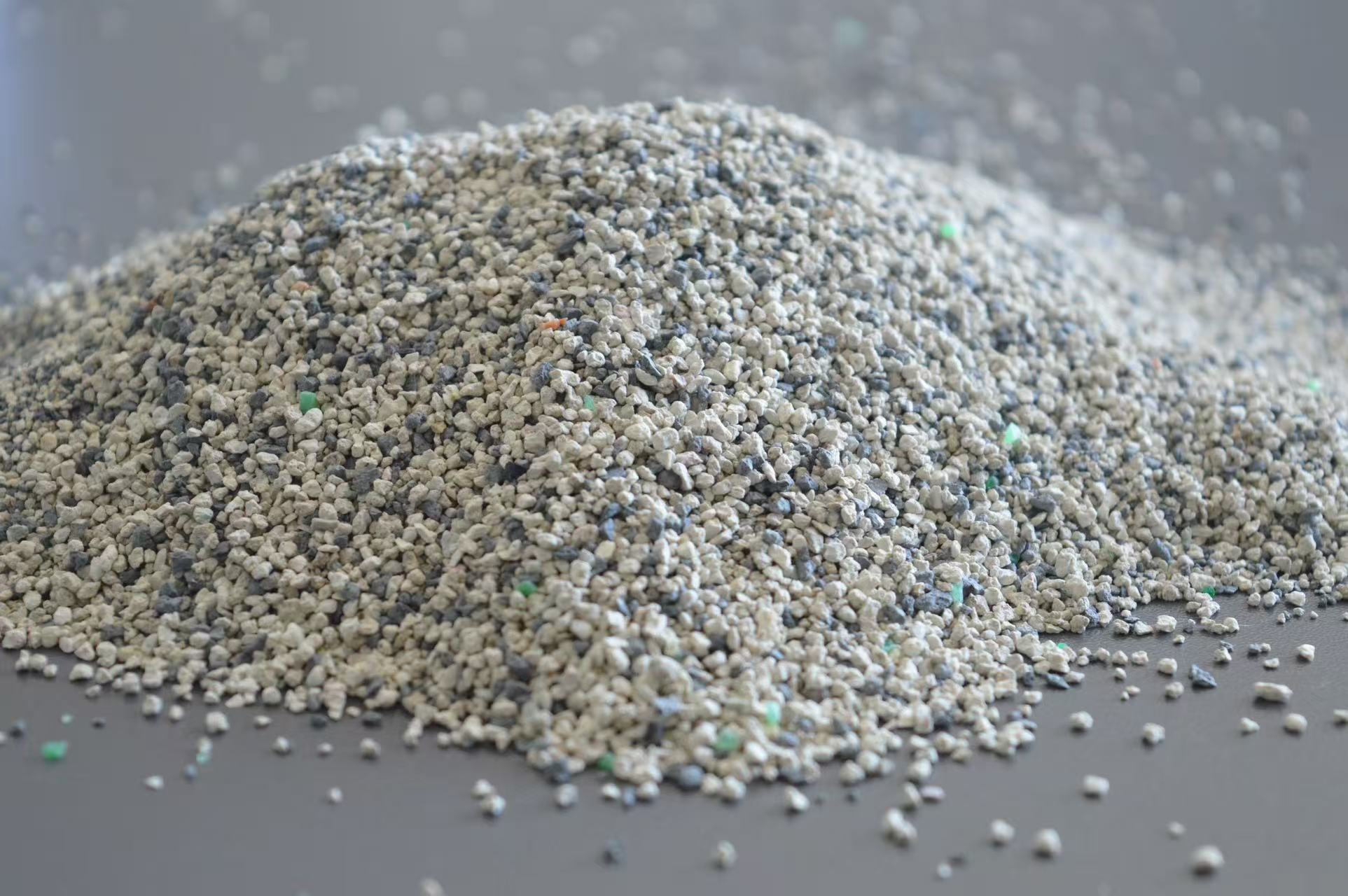

The more meaningful objective is controlled low-dust performance: reducing unnecessary airborne fines while preserving the absorption, clumping and handling qualities that make the litter effective.
For importers, distributors and private-label brands, the useful question is not simply whether a supplier calls the product dust-free. The question is how dust is controlled from raw mineral to finished bag, and how the final product is evaluated after realistic handling.
Low-Dust Bentonite Cat Litter: Why Dust Control Starts Before Packaging
Low dust is not created by one final processing step. It is the result of raw-material selection, particle-size design, screening, dedusting, careful material handling, granule strength and packaging protection.
A product can look clean immediately after production and still release more visible fines after filling, palletising, container loading and long-distance transport. This is why dust control should be treated as a complete manufacturing system rather than a single claim on the bag.
The practical goal is not zero fines. The goal is to control the fine fraction so that the litter performs well when poured, scooped and moved during normal use.
Low-dust performance should be assessed after realistic packaging and handling, not only from an open factory sample.
Why Dust Matters in Real Litter-Box Use
Dust can become visible at several points in the customer experience:
- When a bag is opened.
- When litter is poured into the tray.
- When a cat digs or covers waste.
- When clumps are removed.
- When the remaining fine material is emptied from the bottom of the bag.
For consumers, excess dust can make a litter box and nearby surfaces feel less clean. For retailers and private-label brands, it can lead to complaints even when clumping performance is acceptable.
A well-controlled low-dust formula supports a cleaner handling experience during normal pouring and scooping. However, dust performance must be assessed together with clumping, particle size, tracking and transport stability. Reducing every fine particle is not always the correct technical solution.
Dust Control Begins with Raw-Material Selection
The starting point is the mineral itself. Bentonite quality, natural moisture, hardness, mineral structure and initial fine content all influence how the material behaves during crushing, screening and transport.
A raw material that produces excessive fines during processing can be difficult to convert into a stable low-dust retail product. For clumping cat litter, raw-material selection should support several requirements at the same time:
- Good liquid absorption.
- Reliable clump formation.
- Suitable particle strength.
- Controlled fines generation.
- Stable colour and appearance.
- Consistent processing from batch to batch.
A low-dust product should therefore not be judged only by final visual inspection. Quality control begins before granules are produced.
Particle-Size Design Is the Foundation of Dust Control
Particle size affects almost every major performance point in mineral cat litter. Very fine particles can help fill gaps between larger granules and contribute to clump formation. If their proportion is too high, however, they may create more visible dust during pouring and scooping.
Larger particles can reduce the visual impression of dust in some formulas, but may also change liquid penetration, clump texture and tracking behaviour. Irregular crushed granules and rounded ball-shaped granules can also behave differently depending on the selected size range and the amount of fine material present.
A well-designed particle profile is therefore not simply large particles or small particles. It is a controlled distribution that balances:
- Absorption speed.
- Clump integrity.
- Dust level.
- Tracking tendency.
- Litter-box feel.
- Retail appearance.
- Production cost.
The correct particle design depends on the intended product position. Economy, mid-range and premium litter do not necessarily require the same granule profile.
Screening Removes Unwanted Fines, but Screening Alone Is Not Enough
Screening is an essential part of cat-litter production. It helps separate oversized material, target granules and excess fine particles. However, screening is only one stage of dust control.
Fine particles can also be generated later through:
- Crushing and conveying.
- Granule-to-granule friction.
- Repeated handling during filling.
- Bag movement during container loading.
- Long-distance transport vibration.
- Rough unloading or warehouse handling.
Where dust can enter the process
| Stage | Potential dust source | Practical control focus |
|---|---|---|
| Raw material | Initial fine content and mineral variability | Material selection and incoming quality checks |
| Crushing and screening | Fines generated during size reduction | Particle-size design, screening and dedusting |
| Conveying and filling | Granule friction and repeated transfer | Careful material handling and equipment control |
| Transport | Granule breakage from vibration and movement | Granule strength, packaging protection and loading practice |
| Daily use | Visible dust during pouring, digging and scooping | Finished-product testing and controlled claim wording |
A stronger low-dust approach combines particle-size control with appropriate dedusting, careful material transfer and packaging practices designed to minimize re-breakage.
Granule Strength Affects Dust After Shipment
Dust does not only come from particles that were present before packing. It can also develop when weak granules break during transport.
This is particularly important for export cargo. A bag may pass through factory loading, container stuffing, sea transport, port handling, warehouse movement and retail distribution before reaching the final consumer.
If the granules are too fragile, a product can arrive with more fine material than the original retained sample. Buyers should not evaluate only an open factory sample. They should also discuss how the product will be packed, palletised where relevant, loaded and protected during shipment.
A stable export product requires attention to both granule quality and logistics handling.
Packaging Is Part of Low-Dust Performance
The bag is not only a branding tool. It affects how the product reaches the consumer. Appropriate packaging can help protect granules from moisture, reduce leakage of fine particles and limit unnecessary damage during handling.
Bag material, seal quality, filling weight, headspace and outer-carton or outer-bag arrangement can all influence the final presentation. For private-label projects, dust-control expectations should be discussed together with:
- Bag type and material.
- Retail weight.
- Inner and outer packaging.
- Container loading method.
- Product storage conditions.
- Expected transport route.
- Inspection requirements before shipment.
A premium-looking bag cannot compensate for poor particle control. Good packaging helps preserve a well-made product.
The Balance Between Dust Control and Clumping Performance
A common mistake is to treat all fine particles as unwanted waste. In reality, a controlled fine fraction can contribute to absorption and clump structure. Removing too much may make the litter look cleaner in a dry-pour test but weaken practical clumping performance.
The goal is therefore not zero fines. The goal is controlled fines.
A strong mineral cat litter formula should achieve a practical balance:
- Enough fine material to support absorption and clump formation.
- Limited loose powder that becomes airborne during pouring.
- Suitable granule strength after transport.
- Consistent particle distribution from bag to bag.
This is why low dust must always be evaluated together with clump strength, wet residue, scoopability and tracking. For a broader comparison method, review this guide to evaluating bentonite cat litter quality.
How Buyers Can Compare Dust Performance
A useful supplier comparison needs a repeatable method. Buyers can test samples using the same bag size, product weight and tray or container for every supplier.
A repeatable dust comparison method
- Open the bag and inspect fine material near the opening.
- Pour the same amount of litter from the same height.
- Allow suspended particles to settle before recording the result.
- Stir the litter using the same method.
- Simulate scooping after a clumping test.
- Inspect the bottom of the bag for accumulated fines.
- Repeat after the sample has been transported or shaken under controlled conditions.
This is not a universal laboratory standard, but it provides a more meaningful comparison than visual judgment alone. If a supplier uses a defined dust test method or agrees to a dust-related quality parameter, that method and condition should be documented before commercial production.
Low Dust Should Be a Controlled Claim
For product communication, low dust or controlled dust is more credible than an absolute 100% dust-free statement unless a clear test method and product-specific data support the claim.
Professional wording can include:
- Low-dust mineral cat litter.
- Controlled-dust particle design.
- Screened and dedusted litter options.
- Reduced visible dust during normal pouring and scooping.
- Dust-control options for private-label projects.
This language communicates a real product objective without creating an unsupported absolute promise. It also gives the buyer a clearer basis for sample comparison and production checks.
A controlled claim should be linked to agreed test conditions, the approved sample and the commercial production specification.
A Better Sourcing Discussion for Private-Label Buyers
When discussing low-dust cat litter, buyers should ask:
- What particle-size range is proposed?
- How is the fine fraction controlled?
- Is the litter screened and dedusted?
- How is dust evaluated before shipment?
- Can the product be assessed after transport simulation?
- How does the selected particle design affect clumping and tracking?
- What packaging is recommended for the target market?
- How will the approved sample be matched to commercial production?
These questions help turn low dust from a marketing request into an agreed product specification. Review the standard bentonite cat litter page or the CELAURA 3-in-1 mineral cat litter page for product examples.
To discuss a low-dust sample, particle-size configuration or packaging option for your market, contact Hermano with your target market, litter type, packaging plan and required quality checks.
Low-dust cat litter is not created by one final processing step. It is the result of controlled raw materials, particle-size design, screening, careful material handling, granule strength and packaging protection. The most successful formula is not the one that removes every fine particle. It is the one that balances low visible dust with reliable clumping, good absorption, practical scoopability and stable export quality.
Frequently Asked Questions
Is dust-free cat litter a technical standard?
No. Dust-free is a marketing phrase rather than a universal technical standard for granular mineral litter. A more meaningful description is controlled low-dust performance, supported by a defined test method and product-specific conditions.
Why does low-dust cat litter still contain some fine particles?
A controlled fine fraction can help fill gaps between larger granules and support absorption and clump formation. Removing every fine particle may make a dry sample look cleaner but can weaken practical clumping performance.
When should dust performance be tested?
Test dust when opening the bag, pouring litter, stirring it, scooping a clump and emptying the bottom of the bag. Also assess the product after realistic packaging and transport handling, because granules can break and generate more fines after the factory sample is taken.
How does particle size affect dust and clumping?
Very fine particles may support gap filling and clump formation but can increase visible dust if their proportion is too high. Larger particles may reduce the visual impression of dust but can change liquid penetration, clump texture and tracking.
Why can dust increase after shipment?
Granules can break during filling, palletising, container loading, sea transport, unloading and warehouse movement. If particle strength or packaging protection is insufficient, the delivered product may contain more fines than the retained sample.
Can screening remove all dust from cat litter?
No. Screening removes unwanted fines at one production stage, but additional fines can be generated later through conveying, filling, bag movement, transport vibration and handling. Dust control also depends on particle design, dedusting, granule strength and packaging.
How should a supplier describe low-dust cat litter?
Use wording such as low-dust mineral cat litter, controlled-dust particle design or screened and dedusted litter options. Avoid an absolute dust-free claim unless a clear test method and product-specific data support it.
What should buyers ask before ordering low-dust cat litter?
Ask about the proposed particle-size range, fine-fraction control, screening and dedusting, pre-shipment dust evaluation, transport testing, effects on clumping and tracking, packaging recommendations and how production will be matched to the approved sample.
Technical References
- International Cat Care - cat health and litter-box resources.
- Cornell Feline Health Center - feline health and litter-box resources.
- American Veterinary Medical Association - pet-owner and animal-health information.
- The Clay Minerals Society - clay mineralogy and bentonite-related technical resources.
- U.S. Geological Survey - mineral commodity and geological information.
These references provide general background. They do not constitute certification, endorsement or performance evidence for a Hermano product.

