

Foundry refractory coatings are applied to sand molds and cores to improve casting surface quality, reduce metal penetration and support cleaner mold release.
These coatings commonly contain dense refractory minerals such as zircon, graphite, alumina or silica. Because the solid particles can settle during storage, the formulation needs a rheology-control and suspension additive that keeps the coating stable without making it difficult to apply.
This is the role of foundry coating grade bentonite. It is not simply a viscosity builder. The selected grade should help create a balanced thixotropic structure that supports suspension, application and redispersion in the complete coating system.
Foundry Coating Grade Bentonite for Refractory Coatings
Foundry coating grade bentonite is intended for the refractory coating formulation itself. It should be distinguished from conventional foundry bentonite used as a binder in green-sand molding.
The coating additive has a different job. It works with the refractory filler, binder, carrier liquid and other additives to control flow behaviour and reduce settling. Its performance therefore depends on the coating system, not only on the bentonite grade name.
The objective is not to make the coating as thick as possible. A useful grade should keep heavy solids suspended while still allowing brushing, dipping, flow coating or spraying with an even result.
What Bentonite Does in a Refractory Coating
A properly selected bentonite or organoclay grade can support several related functions:
- Better suspension of zircon, graphite, alumina and other refractory fillers.
- Reduced hard settling during storage and transportation.
- Improved viscosity control and thixotropic behaviour.
- More even application by brushing, dipping, flow coating or spraying.
- Better resistance to sagging, dripping and uneven coating thickness.
- Easier redispersion after storage.
- More consistent coating behaviour from batch to batch.
These functions are connected. A formulation that gives good initial suspension may still be too thick for spraying or leave brush marks. A coating with low viscosity may apply smoothly but settle too quickly, especially when it contains high-density minerals.
The practical target is a controlled rheology profile. The coating should build enough structure at rest to resist sedimentation, then flow or shear in a suitable way during mixing and application.
| Coating issue | Role of a suitable rheology additive | What to verify |
|---|---|---|
| Hard settling | Supports a structured network that helps hold dense refractory particles in suspension. | Settling after storage, temperature variation and transport simulation. |
| Sagging or dripping | Helps control flow after application so the wet coating remains evenly distributed. | Wet-film behaviour, coating thickness and vertical-surface performance. |
| Uneven application | Can improve rheology consistency for brushing, dipping, flow coating or spraying. | Application method, shear conditions and coverage on complex core shapes. |
| Poor redispersion | Supports a structure that can be broken down with practical mixing energy. | Mixing procedure, storage time and ease of returning the coating to a usable state. |
Foundry Coating Grade Bentonite or Molding Sand Bentonite?
Both products may be described as bentonite, but they are selected for different functions. Mixing the two applications can lead to the wrong grade choice and unnecessary formulation trials.
| Product direction | Primary role | Selection focus |
|---|---|---|
| Molding sand bentonite | Used as a binder component in green-sand molding systems. | Sand-system bonding, water demand and molding performance. |
| Foundry coating grade bentonite | Used as a rheology and suspension additive in a refractory coating formulation. | Carrier-liquid compatibility, thixotropy, anti-settling, application behaviour and redispersibility. |
For a coating application, the evaluation should therefore be carried out in the coating itself. A grade that performs well in a molding sand system may not be suitable for a water-based, solvent-based or alcohol-based refractory coating.
Bentonite Selection for Water-Based Foundry Coatings
Water-based refractory coatings can use selected natural or activated inorganic bentonite grades to support thickening, suspension and anti-settling performance.
The grade should be reviewed together with the complete water-based system, including the refractory filler package, binder, dispersing agents, pH and required solids content. Water chemistry and mixing conditions can also affect hydration and rheology development.
Important evaluation points include:
- Hydration and swelling behaviour.
- Particle-size distribution.
- Rheology profile at the required solids content.
- Compatibility with refractory fillers, binders and additives.
- Storage stability and ease of redispersion.
- Application behaviour on molds and cores.
For a water-based coating trial, it is useful to establish the baseline formulation first and then screen the bentonite at controlled addition levels. The accompanying guide to testing bentonite in water-based coatings explains how viscosity and storage stability can be compared. A relevant product direction is bentonite clay for coating and painting.
Organoclay for Solvent-Based or Alcohol-Based Foundry Coatings
For solvent-based or alcohol-based refractory coatings, organophilic bentonite, also known as organoclay, is generally more suitable than untreated inorganic bentonite.
Organoclay can build a controlled thixotropic structure in low-polarity systems and help prevent sedimentation of heavy refractory minerals. The correct grade, activator level and incorporation procedure should be evaluated in the actual coating formulation.
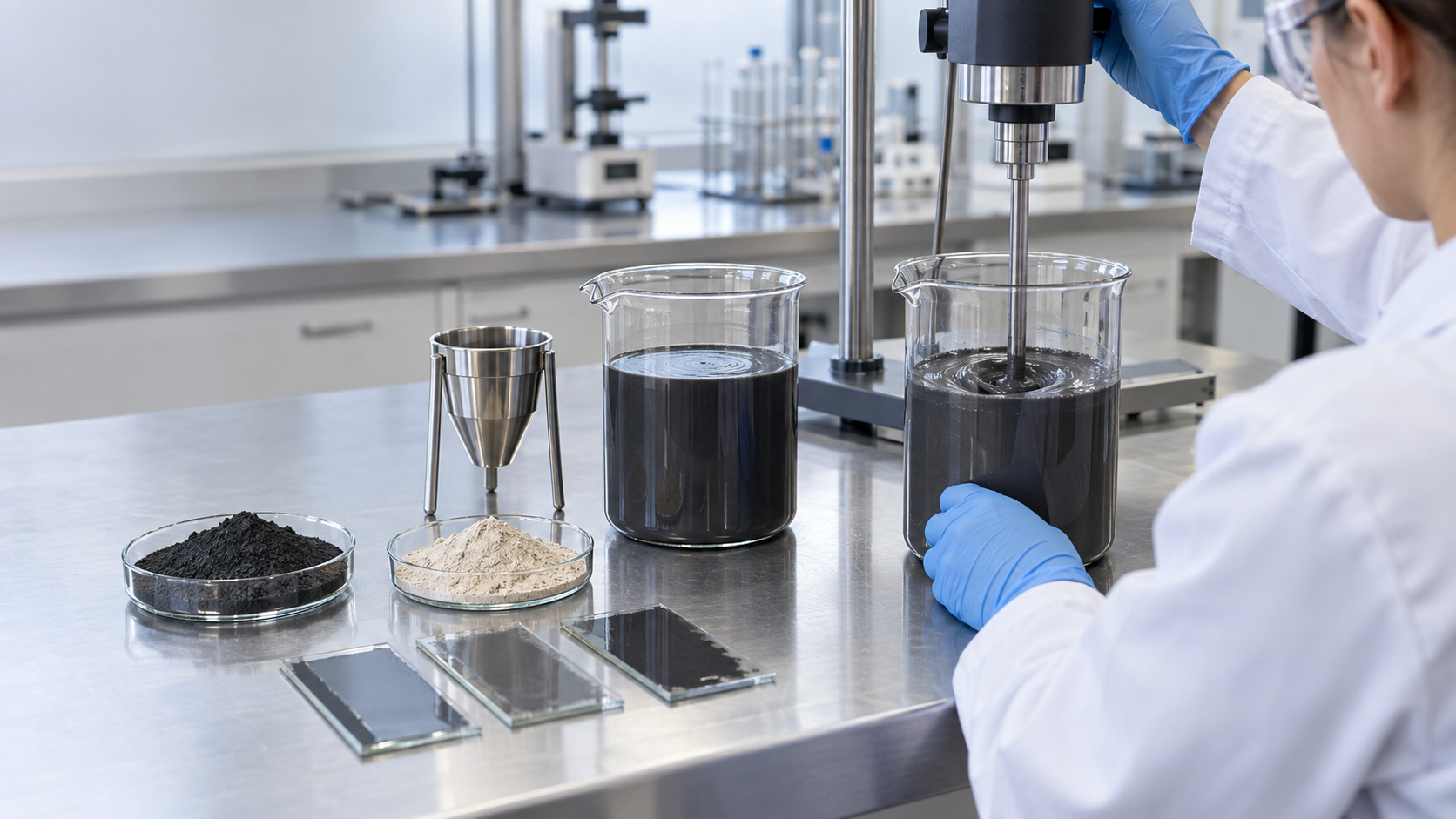
The solvent or alcohol blend is especially important. Polarity, water content, binder type and processing temperature can all change how the organoclay disperses and develops viscosity. A grade that works in one solvent system may require a different activation or addition procedure in another.
For background on selecting between inorganic bentonite and organoclay, review the guide to inorganic bentonite vs organoclay. The relevant material family is described on the organophilic bentonite for solvent-based coatings page.
Why the Complete Formulation Determines Performance
Foundry coating performance depends on more than the clay itself. Before selecting a grade, the following formulation and process variables should be reviewed:
- Type and density of refractory filler.
- Water, solvent or alcohol carrier system.
- Resin or binder chemistry.
- Solids content and target coating thickness.
- Dispersing agents, wetting agents and other additives.
- Activator type and addition procedure, where applicable.
- Mixing equipment, shear level and incorporation sequence.
- Brushing, dipping, flow coating or spraying method.
- Storage conditions and expected shelf life.
Small changes in one of these variables can affect viscosity, settling and application behaviour. For this reason, the most reliable selection method is a controlled laboratory trial in the customer's own coating system.
Tests to Run in the Customer's Coating System
A useful evaluation should cover both freshly prepared coating and coating that has been stored under realistic conditions. Important tests may include:
| Test area | What it helps reveal |
|---|---|
| Initial viscosity and rheology | Whether the coating can be mixed, pumped or applied at the required solids content. |
| Storage viscosity | Whether the rheology profile remains practical after ageing. |
| Settling tendency | How well heavy refractory minerals remain suspended. |
| Redispersibility | How easily settled or thickened material can be returned to a usable state. |
| Application behaviour | Coverage and flow control during brushing, dipping, flow coating or spraying. |
| Coating thickness and uniformity | Whether the coating can be applied consistently across different mold and core surfaces. |
| Sag resistance | Whether the wet coating remains in place on vertical or complex surfaces. |
| Casting surface quality | Whether the coating supports the intended surface result after actual foundry use. |
Adding more rheology additive is not always the correct response to a coating problem. Excessive structure can reduce flow, trap air or make application difficult. The grade and addition level should be optimised together.
Common Foundry Coating Problems and First Checks
When a refractory coating does not behave as expected, the bentonite grade may be only one part of the issue. The following checks can help separate a rheology problem from a formulation or process problem.
| Problem | Useful first checks |
|---|---|
| Hard settling during storage | Review filler density and particle-size distribution, rheology profile, storage temperature and redispersion procedure. |
| Low viscosity after mixing | Confirm the clay has been properly wetted or activated, check addition sequence and review compatibility with the carrier liquid. |
| Sagging or dripping | Compare rheology at low shear, coating thickness, solids content and substrate condition. |
| Uneven application | Check the shear conditions of the selected application method, mixing quality and coating flow profile. |
| Poor redispersion after storage | Review the strength of the thixotropic structure, ageing behaviour and the mixing energy available in production. |
A single viscosity reading cannot explain all of these issues. Initial viscosity, low-shear structure, shear-thinning behaviour and recovery after shear should be considered together.
Information to Include in a Sample Request
To evaluate a suitable foundry coating grade, please share the following information:
- Water-based, solvent-based or alcohol-based coating system.
- Main refractory filler and approximate filler loading.
- Binder or resin system.
- Carrier liquid or solvent blend.
- Solids content and target coating thickness.
- Application method: brushing, dipping, flow coating or spraying.
- Current rheology additive and addition level, if applicable.
- Main problem to solve, such as hard settling, sagging, uneven coverage or poor redispersion.
- Mixing equipment, incorporation sequence and available shear.
- Storage and transportation conditions.
This information allows a more useful grade recommendation and helps define what should be measured during the trial. Hermano can provide application-oriented product selection, TDS, COA, MSDS and small samples for formulation evaluation. To discuss a specific coating system, contact Hermano with the details above.
Frequently Asked Questions
What is foundry coating grade bentonite used for?
It is used as a rheology and suspension additive in refractory coating formulations for sand molds and cores. It can help control viscosity, reduce settling and support even application.
Is it the same as bentonite for green-sand molding?
No. Molding sand bentonite is intended for the sand system itself. Foundry coating grade bentonite is selected for the refractory coating formulation, where suspension and rheology control are the main functions.
Can bentonite be used in water-based foundry coatings?
Yes. Selected natural or activated inorganic bentonite grades can be evaluated for thickening, suspension and anti-settling performance in water-based refractory coatings. Suitability should be confirmed in the complete formulation.
What additive is used in solvent-based or alcohol-based foundry coatings?
Organophilic bentonite, also called organoclay, is generally more suitable for solvent-based or alcohol-based systems. The correct grade, activator level and incorporation procedure should be confirmed through formulation testing.
Why should viscosity not be increased without considering application?
Excessive structure can reduce flow, make application difficult and affect coating uniformity. The additive should provide enough low-shear structure to suspend solids while still allowing practical brushing, dipping, flow coating or spraying.
What causes hard settling in refractory coatings?
Hard settling can be related to filler density, particle-size distribution, rheology structure, carrier-liquid compatibility, storage conditions and insufficient redispersion. These factors should be reviewed together.
What information is needed for grade selection?
Useful information includes the coating type, refractory filler, binder system, carrier liquid, solids content, application method, current additive, mixing procedure and the specific performance issue to solve.
Are technical documents and evaluation samples available?
TDS, COA, MSDS and small samples can be discussed for a suitable application. The relevant documents should be confirmed for the selected grade and intended coating system.
Technical References
- Bentonite clay for coating and painting - material direction for water-based coating systems.
- Organophilic bentonite for solvent-based coatings - organoclay family and application context.
- Inorganic bentonite vs organoclay - comparison guide for coating systems.
- How to test bentonite in water-based coatings - viscosity and storage-stability evaluation.
- American Foundry Society - metalcasting process and industry resources.
- ASTM International - standards and test-method resources.

