

Industrial water-treatment systems often need several mechanisms to work together: adsorption, suspended-solids removal, coagulation support, settling improvement and sludge conditioning.
Water treatment grade bentonite can support selected functions because of its layered mineral structure, fine particle size and adsorption capacity. It can be used as a process aid in industrial wastewater treatment and sludge-handling systems.
Its effect should always be evaluated in the actual water chemistry and treatment process. Bentonite is not a universal replacement for coagulants, flocculants, activated carbon, filtration media or other treatment chemicals.
Where Water Treatment Grade Bentonite Fits
Bentonite is mainly composed of montmorillonite, a clay mineral with a high surface area and ion-exchange capacity. When dispersed in water, selected grades can interact with fine suspended particles and certain dissolved or dispersed contaminants.
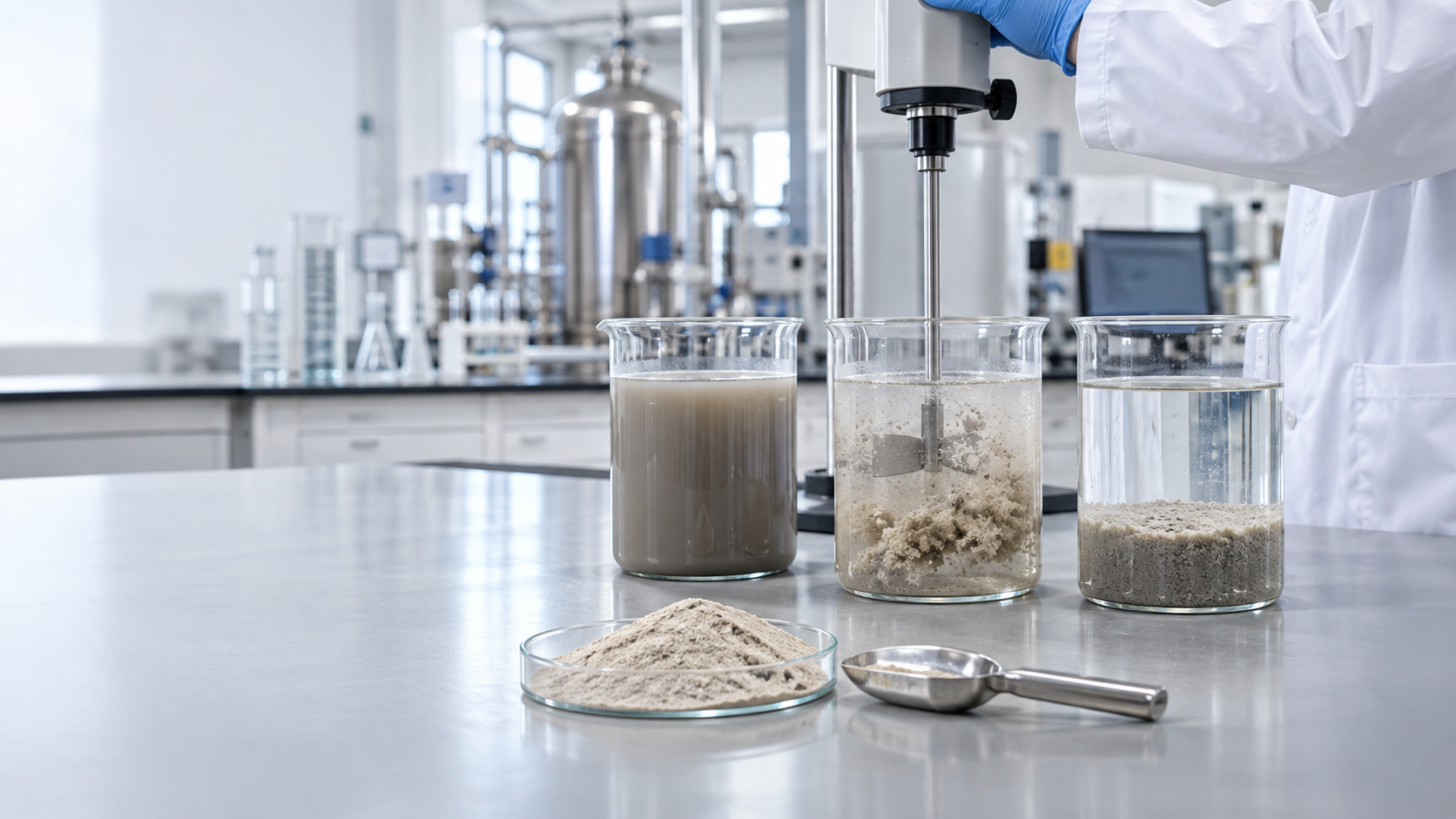
The material is best considered as part of a treatment train, not as a single additive that solves every water-quality problem. A grade may improve one part of the process while having little effect on another.
A useful evaluation should compare the complete treatment sequence with and without bentonite. Testing the clay alone may not show how it performs with the coagulants, flocculants or polymers already used in the plant.
How Bentonite Works in Water Treatment
In water-treatment applications, bentonite may help with:
- Adsorption of selected impurities and organic contaminants.
- Supporting removal of fine suspended solids.
- Improving clarification when used with suitable coagulants or flocculants.
- Assisting separation of oil-containing or pigment-containing wastewater.
- Supporting treatment of wastewater from mineral processing, coatings, paper, textile and other industries.
- Conditioning sludge before dewatering or handling.
- Reducing free-water release in selected sludge-treatment systems.
The actual effect depends on the bentonite grade, dosage, pH, conductivity, contaminant type, treatment chemicals and process design. These variables should be reviewed together rather than treated as separate selection points.
| Treatment function | Practical role | Main dependencies |
|---|---|---|
| Adsorption | Provides additional mineral surface for interaction with selected impurities. | Contaminant type, clay grade, dosage and water chemistry. |
| Clarification support | Can interact with fine solids and help create more separable particles. | Coagulant or flocculant combination, mixing and pH. |
| Settling improvement | May support denser solids and better separation in suitable systems. | Solids concentration, treatment sequence and residence time. |
| Sludge conditioning | Can be evaluated for effects on sludge structure and water release. | Sludge type, chemistry, dose and dewatering method. |
Bentonite as an Adsorption and Clarification Aid
Fine particles, oils, colour bodies and other dispersed materials can be difficult to remove from industrial wastewater. Bentonite can provide additional mineral surface area for adsorption and particle interaction.
In clarification systems, it is commonly evaluated together with coagulants and flocculants rather than as a stand-alone chemical. The correct combination may help form denser, more separable solids and improve settling behaviour.
A treatment trial should not focus on one number alone. The following evaluation targets are useful when comparing grades or addition levels:
| Evaluation target | What to observe |
|---|---|
| Turbidity reduction | Whether fine suspended particles are removed more effectively. |
| Settling rate | How quickly solids separate under the selected treatment conditions. |
| Supernatant clarity | Whether the treated water becomes more visually clear after separation. |
| Sludge volume | How much settled material is produced and whether the volume remains manageable. |
| Filterability | Whether the solids can be processed efficiently by the selected separation equipment. |
| Final moisture of dewatered sludge | Whether dewatering performance improves without creating another operational problem. |
A lower turbidity result is useful, but it should be reviewed together with sludge volume, settling time, chemical consumption and dewatering performance. A treatment that improves clarity while producing an unmanageable sludge may not be practical.
Industrial Wastewater and Sludge Treatment Applications
Water treatment grade bentonite may be considered in a range of industrial processes, including:
- Coating and paint wastewater.
- Paper-making wastewater.
- Textile and dye-containing wastewater.
- Mining and mineral-processing wastewater.
- Oil-contaminated industrial wastewater.
- Chemical-process wastewater.
- Sludge conditioning and dewatering operations.
Different wastewater streams require different bentonite types. Natural bentonite may be suitable for some aqueous clarification and sludge applications, while activated or specially processed grades may be considered where different adsorption or rheology behaviour is required.
These are evaluation directions, not universal recommendations. Wastewater composition can change from one plant to another and even between production batches. Grade selection should therefore be based on representative water and sludge samples.
Key Factors for Selecting Water Treatment Grade Bentonite
A suitable grade should be selected based on the complete treatment process, not only on a single clay parameter.
| Selection factor | Why it matters |
|---|---|
| Montmorillonite content and adsorption capacity | Helps indicate the mineral's functional potential, but the result still depends on the actual contaminants. |
| Particle-size distribution | Can affect dispersion, reaction time, settling behaviour and solids separation. |
| Swelling and dispersion behaviour | Influences how the clay breaks down and interacts in the treatment system. |
| Cation-exchange characteristics | Can affect interaction with dissolved species and other treatment additives. |
| Moisture and mineral purity | Contributes to dosage consistency, handling and process predictability. |
| Wastewater pH | Affects clay surface behaviour, coagulation chemistry and overall treatment response. |
| Contaminant type and concentration | Determines whether adsorption, clarification or another treatment mechanism is more relevant. |
| Compatibility with coagulants and polymers | Influences floc formation, settling and separation performance. |
| Treatment equipment and residence time | Determines how much mixing, contact time and separation capacity are available. |
| Sludge-handling requirements | Links treatment performance to dewatering, transport and disposal costs. |
Jar Testing: A Practical Way to Compare Grades
Bench-scale jar tests are recommended before commercial use. They provide a practical way to compare bentonite grades, addition levels and combinations with other treatment chemicals under controlled conditions.
A structured trial can follow this sequence:
- Characterise the wastewater source, pH, suspended solids and main contaminants.
- Establish a baseline using the current treatment chemicals and process sequence.
- Prepare each bentonite dispersion in a consistent way.
- Test several bentonite addition levels, both alone and with the existing coagulant or flocculant programme.
- Keep mixing speed, mixing time and settling time consistent between trials.
- Measure turbidity, settling rate, supernatant clarity, sludge volume, filterability and final sludge moisture where relevant.
- Repeat the most promising conditions to confirm that the result is reproducible.
The best bentonite grade is not always the one that produces the clearest water in the shortest time. The practical choice should also consider chemical consumption, sludge volume, dewatering performance, handling and cost.
Common Reasons Bentonite Trials Can Be Misleading
Small differences in test design can produce large differences in apparent performance. These issues are common when comparing water-treatment additives:
| Trial issue | Effect on the result |
|---|---|
| Comparing grades at only one dosage | The best grade at a low dose may not remain the best at the optimum dose. |
| Changing mixing speed or time | Floc formation and settling can change even when the formulation is the same. |
| Ignoring pH | Clay behaviour and coagulant performance are strongly affected by water chemistry. |
| Testing bentonite alone | The result may not reflect how the material performs in the existing treatment sequence. |
| Using only a short settling period | Slow-forming or denser flocs may be missed before they reach their potential. |
| Measuring only turbidity | Sludge volume, filterability and dewatering performance may still make the option impractical. |
For a meaningful comparison, the test conditions should be documented and kept as consistent as possible. The treatment objective should also be defined before the trial, not selected after the results are known.
What to Include in a Sample Request
To evaluate a suitable water treatment grade, please share the following information:
- Water or wastewater source and process type.
- Main contaminants, colour, oil content and suspended solids.
- pH range, conductivity and typical variation.
- Current coagulants, flocculants, polymers or other treatment chemicals.
- Existing dosage ranges and treatment sequence.
- Treatment equipment, mixing conditions and residence time.
- Target result, such as turbidity reduction, faster settling, lower sludge volume or improved dewatering.
- Sludge-handling and disposal requirements.
- Desired sample quantity for jar testing or pilot evaluation.
Natural and activated grades can be reviewed according to the application. Premium white bentonite with natural and sodium-activated options is one product direction for applications where grade selection is based on dispersion, swelling and process requirements. Hermano can provide product recommendations, TDS, COA, MSDS and samples for jar testing. To discuss a specific water-treatment process, contact Hermano with the information above.
Frequently Asked Questions
What is water treatment grade bentonite used for?
It can be evaluated as a process aid for selected adsorption, clarification, settling and sludge-conditioning applications. Its performance depends on the wastewater chemistry, treatment chemicals and process design.
Does bentonite replace coagulants or flocculants?
No. Bentonite is generally evaluated together with suitable coagulants or flocculants. It is not considered a universal replacement for those treatment chemicals.
Can bentonite improve sludge dewatering?
It can be evaluated as part of sludge conditioning and dewatering, but the result depends on the sludge type, chemistry, dosage and dewatering method. Bench testing is needed to confirm the effect.
Which bentonite grade is suitable for wastewater treatment?
The suitable grade depends on the water chemistry, contaminants, treatment sequence and target result. Natural, activated or specially processed grades may be considered, but selection should be confirmed through testing.
Why are jar tests needed before commercial use?
Jar tests allow different bentonite grades, addition levels and chemical combinations to be compared under controlled conditions before changing a full-scale treatment process.
What results should be measured in a jar test?
Useful measurements include turbidity, settling rate, supernatant clarity, sludge volume, filterability and final moisture of dewatered sludge where applicable.
What factors affect bentonite performance in water treatment?
Important factors include bentonite grade, dosage, pH, conductivity, contaminant type, coexisting treatment chemicals, mixing conditions and treatment equipment.
Are samples and technical documents available?
TDS, COA, MSDS and samples for jar testing can be discussed for a suitable application. The relevant documents should be confirmed for the selected grade and intended process.
Technical References
- Hermano bentonite product collection - natural, activated and application-oriented bentonite directions.
- Premium white bentonite with natural and sodium-activated grades - grade selection and processing options.
- Contact Hermano - discuss a water-treatment evaluation or sample request.
- U.S. EPA Water Research - water treatment and water-quality research resources.
- American Water Works Association - drinking water and treatment industry resources.
- The Clay Minerals Society - clay mineralogy and montmorillonite-related resources.
- USGS Water Resources - water science and resource information.

