

Flame-retardant materials are used in plastics, rubber, coatings, textiles, cable compounds, construction boards and sealants.
In many formulations, the main flame-retardant package includes aluminum hydroxide, magnesium hydroxide, phosphorus-based additives, expandable graphite or intumescent components. Bentonite is not normally used as a stand-alone flame retardant.
Its layered mineral structure and barrier-forming behaviour can, however, make it a useful functional synergist in selected systems. The key question is whether it improves the complete formulation without harming processing, mechanical properties or the intended fire-test result.
What Bentonite Can Contribute to a Flame-Retardant Formulation
Bentonite is mainly composed of montmorillonite, a layered silicate mineral with a high aspect ratio and a large surface area. When properly dispersed in a polymer, coating or rubber matrix, the mineral layers may influence heat and mass transfer during combustion.
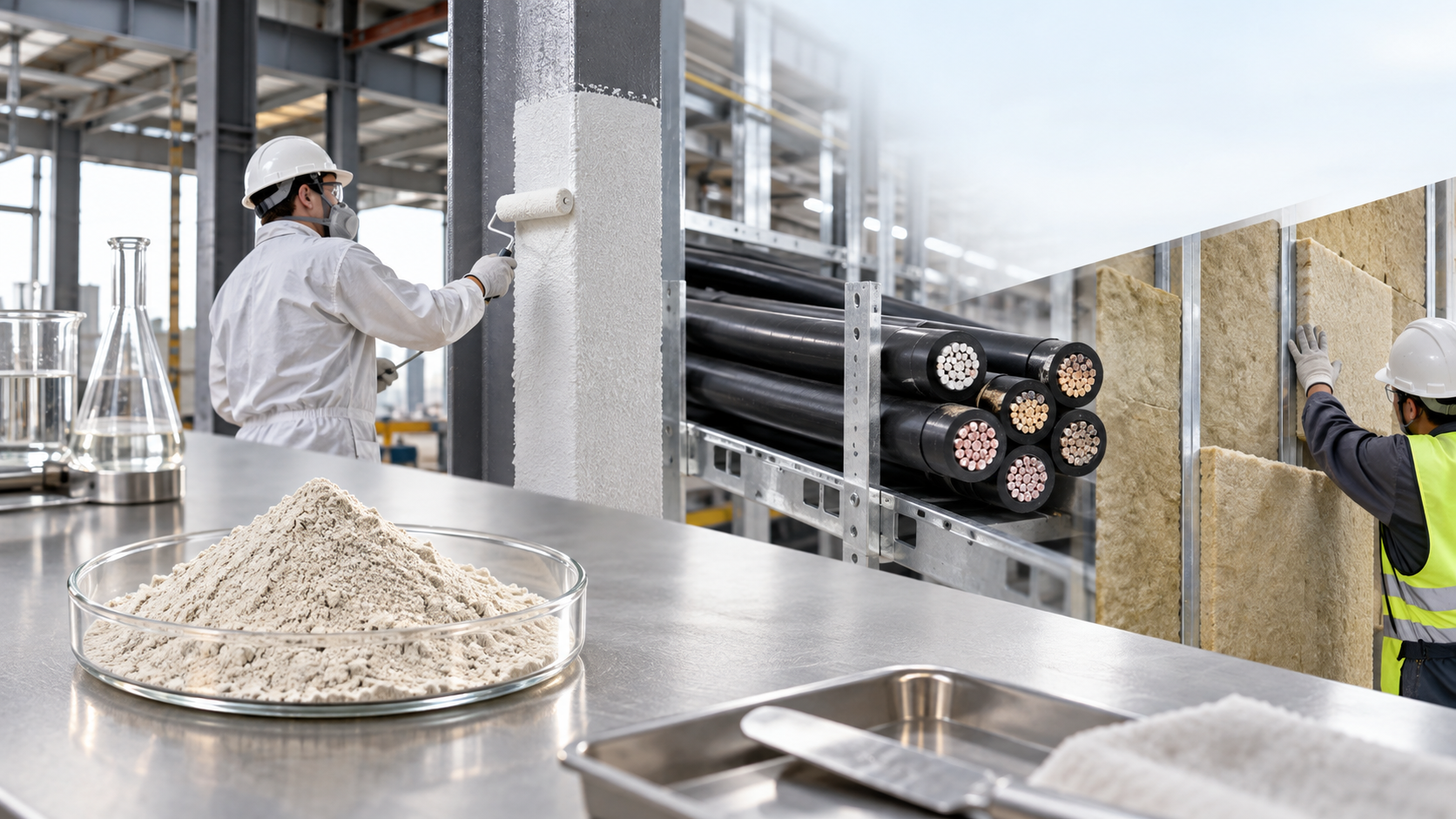
In selected systems, well-dispersed bentonite may contribute to:
- Formation of a more compact protective char layer.
- Reduced heat transfer into the substrate.
- Slower migration of combustible volatile gases.
- Lower oxygen diffusion toward the burning surface.
- Improved cohesion of the carbonized layer.
- Better anti-dripping performance in some polymer systems.
- Reduced cracking or shrinkage in protective coatings.
These mechanisms can complement primary flame-retardant additives, but they do not guarantee a specific fire rating or test result. Performance must be confirmed through formulation testing.
A visible improvement in char structure is useful, but it is not proof of compliance with a fire-safety standard. The complete material or coated assembly still needs the relevant test method and acceptance criteria.
Why Dispersion Matters More Than Clay Loading
Bentonite cannot provide the intended barrier effect if it remains in large agglomerates. Poor dispersion may reduce mechanical properties, create surface defects or prevent the mineral layers from interacting effectively with the polymer or coating matrix.
The suitable surface chemistry depends on the carrier system:
- Water-based systems can be evaluated with selected natural sodium bentonite or another inorganic rheology-grade bentonite.
- Solvent-based, oil-based or non-polar polymer systems may require organophilic bentonite or surface-treated clay for better compatibility.
- PVC, EVA, rubber and cable compounds may need a fine bentonite, modified bentonite or organoclay depending on the polymer and processing method.
The grade should be selected together with the dispersion process. Addition order, mixing energy, temperature and compatibility with other additives can all affect the final result.
Bentonite in Intumescent Flame-Retardant Coatings
Intumescent coatings expand under fire exposure and form an insulating char layer that can protect steel, wood or other substrates. The stability and integrity of this expanded char are critical.
Fine bentonite can be evaluated as a reinforcing mineral component in these formulations. Its platelet structure may help strengthen the char skeleton and reduce the tendency of the expanded layer to crack, collapse or detach under high temperatures.
In water-based fire-retardant coatings, bentonite may also assist with rheology control, anti-settling performance and storage stability. The suitable grade should be selected according to the coating system, pigment loading, binder type and target viscosity.
An inorganic rheology-grade direction is described on the bentonite clay for coating and painting page. The wider comparison between inorganic bentonite and organoclay is covered in the guide to bentonite selection for coating systems.
Plastics and Rubber: Matching Clay Surface Chemistry to the Polymer
Bentonite can be considered for flame-retardant plastic and rubber compounds, particularly where mineral reinforcement and barrier effects are also of interest.
Potential application areas include:
- Cable and wire insulation compounds.
- PVC products.
- EVA and polyolefin compounds.
- Rubber sheets, belts and seals.
- Construction membranes.
- Automotive interior components.
- Flame-retardant masterbatch systems.
For non-polar polymers, natural sodium bentonite often has limited compatibility. Organophilic bentonite or surface-treated clay may provide better dispersion in solvent-based, oil-based or non-polar polymer systems. The relevant material direction is covered on the organophilic bentonite for solvent-based systems page.
| Formulation system | Bentonite direction to evaluate | What to verify |
|---|---|---|
| Water-based fire-retardant coating | Natural sodium bentonite or another suitable inorganic rheology-grade bentonite. | Dispersion, viscosity, anti-settling, storage stability and char integrity. |
| Solvent-based coating | Organophilic bentonite compatible with the solvent polarity. | Activation, dispersion, viscosity development and coating uniformity. |
| PVC, EVA, rubber or cable compound | Fine bentonite, modified bentonite or organoclay depending on polymer compatibility. | Dispersion, processing behaviour, mechanical properties and flame-test performance. |
| Intumescent coating | Fine particle-size bentonite with stable rheology and good dispersion. | Char expansion, char integrity, coating thickness and substrate protection. |
| Expandable graphite compound | Fine, low-impurity bentonite for char reinforcement and barrier support. | Expansion efficiency, char compactness, mechanical properties and mineral loading. |
Bentonite with Expandable Graphite Systems
Expandable graphite is an effective intumescent flame-retardant material, but its expanded char can sometimes be fragile. Bentonite may be used together with expandable graphite to help improve char compactness and structural strength.
In this type of formulation, bentonite can contribute a mineral barrier effect while graphite creates the expansion and insulation structure. The mechanism depends on both components being properly dispersed and distributed.
The exact ratio must be optimised through laboratory testing. Excessive mineral loading may affect mechanical properties, processing behaviour or expansion efficiency, while too little may not provide the intended char reinforcement.
How to Select the Right Bentonite Grade
The appropriate bentonite depends on the formulation, processing method and target fire-test result. A low price or a single specification value is not enough to determine suitability.
| Technical indicator | Why it matters |
|---|---|
| Particle-size distribution | Affects dispersion, barrier formation, coating rheology and mechanical properties. |
| Moisture | Can influence processing, storage and consistency in polymer or coating systems. |
| Swelling capacity | Important for water-based rheology and dispersion behaviour, but not a direct measure of flame performance. |
| Cation-exchange capacity | Can influence surface activity, compatibility and interaction with other formulation components. |
| Rheological behaviour | Affects coating application, anti-settling performance and storage stability. |
| Colour and impurity level | May matter for appearance, processing and compatibility in some final products. |
| Compatibility with the complete formulation | Determines whether the grade can be dispersed and retained without harming other properties. |
These indicators should be reviewed together with the primary flame-retardant package. A grade that performs well in one polymer or coating cannot be assumed to perform the same way in another system.
Formulation Testing: What to Compare
Bentonite should be evaluated as part of the complete flame-retardant package rather than assessed alone. Its performance can be influenced by the resin, flame-retardant type, pigment system, dispersant, processing method and dosage.
Key evaluations may include:
- Limiting Oxygen Index.
- UL-94 vertical burning test.
- Cone calorimeter testing.
- Smoke density testing.
- Thermogravimetric analysis.
- Char expansion and char integrity evaluation.
- Mechanical properties and processing behaviour.
- Coating viscosity, storage stability and anti-settling performance.
The selected test programme should reflect the final material, application method and regulatory or customer requirement. A small laboratory screening programme is usually the most practical way to identify the optimum grade and dosage before larger-scale trials.
For water-based coating systems, the guide to testing viscosity and storage stability can help establish a more consistent baseline before fire-performance testing.
A Practical Laboratory Screening Sequence
A structured screening sequence can reduce the risk of drawing conclusions from an unstable or poorly dispersed sample:
- Establish the baseline formulation without bentonite and record its processing and test performance.
- Confirm the bentonite dispersion method and check for visible agglomerates.
- Screen several addition levels rather than testing only one dosage.
- Keep processing temperature, mixing time and sample preparation consistent.
- Compare fire-test performance together with mechanical, rheological and processing properties.
- Inspect char structure after testing, including expansion, compactness, cracking and adhesion.
- Repeat the most promising formulation to confirm reproducibility.
The best result is not always the formulation with the highest mineral loading. The useful balance is enough barrier support to improve performance without causing unacceptable mechanical, processing or application losses.
Common Misinterpretations to Avoid
| Misinterpretation | Practical concern |
|---|---|
| Bentonite can replace the primary flame retardant. | It is normally evaluated as a synergist, not as a stand-alone flame-retardant system. |
| More bentonite will always improve fire performance. | Excess loading can affect dispersion, expansion, mechanical properties or processing. |
| Better char appearance guarantees a better fire rating. | Formal performance depends on the relevant test method and complete material or assembly. |
| One grade can be used in every polymer or coating. | Surface chemistry, polarity, processing and additive interactions can change the result. |
| Laboratory success can be scaled up without adjustment. | Mixing, residence time, temperature and equipment can change dispersion and final performance. |
Information to Include in a Sample Request
To evaluate a suitable bentonite grade, please share the following information:
- Application type, such as coating, plastic compound, rubber, cable material, sealant or board.
- Polymer, resin, binder or carrier system.
- Primary flame-retardant package and current loading.
- Target test methods and required performance level.
- Processing method, temperature, mixing equipment and dispersion sequence.
- Required particle size, moisture, rheology or compatibility characteristics.
- Current bentonite or mineral filler, if applicable.
- Main problem to solve, such as settling, char cracking, poor dispersion or mechanical loss.
- Sample quantity needed for laboratory evaluation.
Natural, sodium-activated and organophilic bentonite grades can be reviewed according to the formulation. Premium white bentonite with natural and sodium-activated options is one material direction for applications where dispersion, swelling and processing requirements guide grade selection. Hermano can provide technical data and samples for evaluation. To discuss a specific system, contact Hermano with the details above.
Frequently Asked Questions
Is bentonite a stand-alone flame retardant?
No. Bentonite is normally evaluated as a functional mineral synergist within a complete flame-retardant package. It does not replace the primary flame-retardant additives.
How can bentonite support flame retardancy?
When properly dispersed, its layered mineral structure may contribute to char formation, barrier effects and improved cohesion of the protective layer in selected systems.
Which bentonite is suitable for water-based intumescent coatings?
Selected natural sodium or inorganic rheology-grade bentonite can be evaluated. Dispersion, viscosity, anti-settling behaviour, storage stability and char integrity should be tested in the actual coating.
Which bentonite is suitable for non-polar polymers?
Organophilic bentonite or surface-treated clay may provide better compatibility in non-polar or solvent-based systems. The suitable grade depends on the polymer, solvent or process.
Can bentonite replace ATH, MDH or phosphorus flame retardants?
No. Bentonite is generally considered as a synergist or mineral component. The primary flame-retardant package still needs to be selected and tested for the application.
What tests should be used to evaluate bentonite in a flame-retardant system?
Relevant tests may include Limiting Oxygen Index, UL-94, cone calorimeter, smoke density, thermogravimetric analysis, char integrity, mechanical properties and processing behaviour.
How much bentonite should be added?
The suitable dosage depends on the polymer or coating system, primary flame-retardant package, dispersion method and target performance. Several addition levels should be compared in laboratory testing.
Are samples and technical documents available?
TDS, COA and samples can be discussed for a suitable application. The relevant documents should be confirmed for the selected grade and intended formulation.
Technical References
- Hermano bentonite product collection - natural, modified and application-oriented material directions.
- Bentonite clay for coating and painting - inorganic rheology additive direction for water-based coatings.
- Organophilic bentonite for solvent-based systems - compatibility and dispersion in solvent-based formulations.
- Inorganic bentonite vs organoclay - comparison guide for carrier and polymer systems.
- NIST Fire Research - fire science, material behaviour and fire-safety research resources.
- ASTM International - standards and test-method resources.
- ISO - international standards for materials and testing.

