

Bentonite is often added to a ceramic body in a small amount to improve plasticity, forming behaviour and green strength. When a new grade is evaluated, ceramic producers may notice that its loss on ignition (LOI) is higher than that of some other raw materials.
Does a higher LOI make the bentonite unsuitable? The answer depends on what is being lost, when it is released during heating, and how much bentonite is used in the complete body. LOI is a useful screening value, but it cannot predict firing performance on its own.
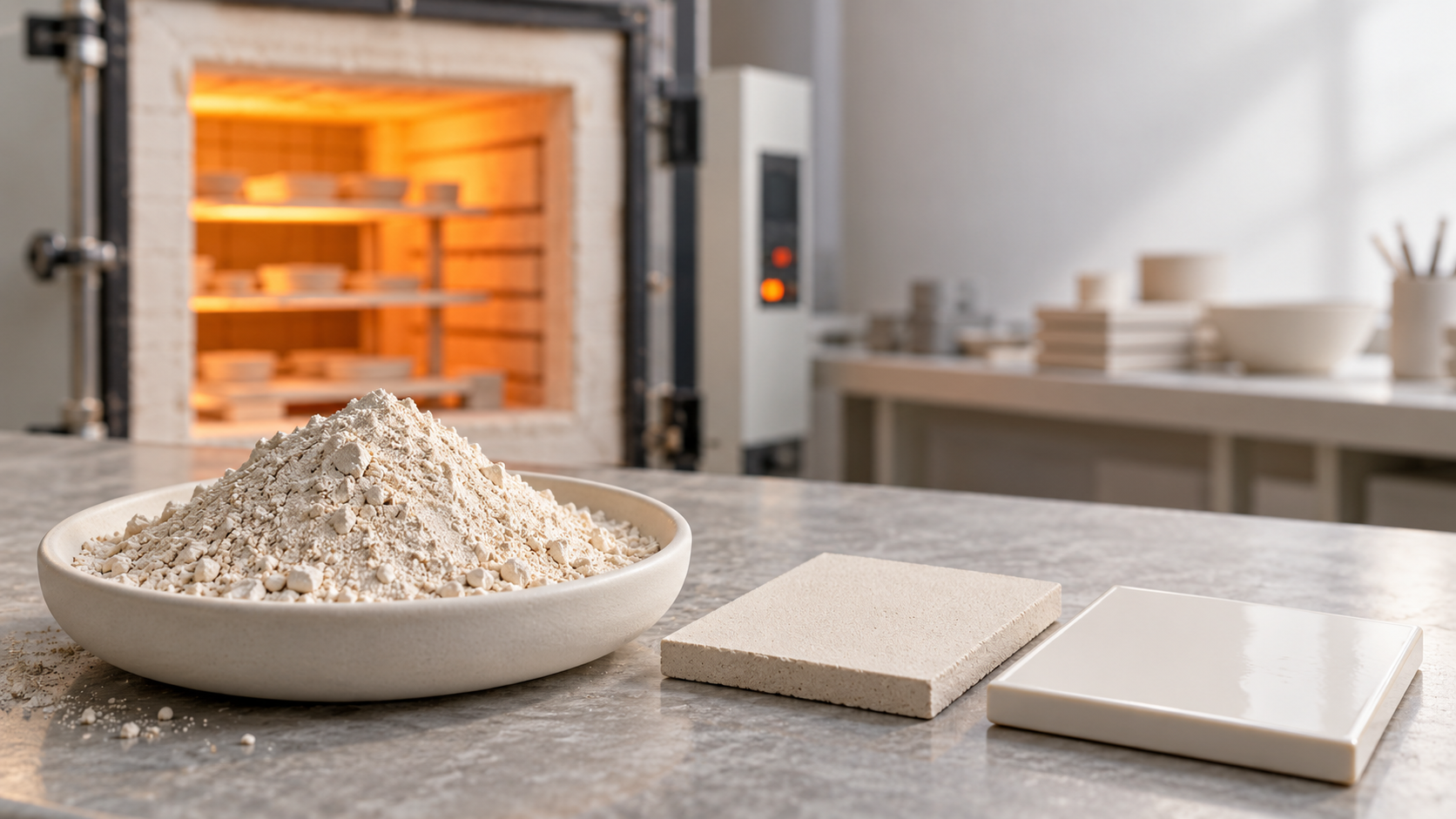
This article explains what a bentonite LOI value does and does not tell us, why different components are released at different stages of firing, and how a ceramic manufacturer can evaluate a candidate grade in the actual body formulation.
What Is Loss on Ignition?
Loss on ignition is the percentage of mass a sample loses when it is heated under a defined laboratory procedure. It is normally calculated from the mass before and after ignition:
LOI (%) = (mass before ignition − mass after ignition) ÷ mass before ignition × 100
The result depends on sample preparation, starting moisture condition, final temperature, holding time and atmosphere. For a meaningful comparison, the supplier and the ceramic manufacturer should use the same method and report whether the starting mass is measured on an as-received or a pre-dried basis.
LOI should also be distinguished from ordinary moisture content. Drying a sample at approximately 105 °C removes much of its free and adsorbed water, but the amount of interlayer water remaining in bentonite can depend on the clay and the drying procedure. Further heating can then release additional water and other volatile components.
| Reporting basis | What the starting mass includes | Practical meaning |
|---|---|---|
| As-received | Free moisture plus mineral solids | Reflects the sample as delivered, but is sensitive to storage and humidity |
| Pre-dried basis | Mineral solids after removal of most free water | Gives a more comparable, mineral-based value |
| Different final temperature, hold time or atmosphere | Varies with the method used | Results from two laboratories may not be directly comparable |
A single number is only meaningful when its method and reporting basis are known. This is why LOI figures from different sources should be compared with care.
Why Bentonite Loses Mass During Firing
Bentonite commonly contains montmorillonite, a smectite clay mineral. Its mass loss during heating can come from several sources, and these processes often overlap.
| Source of mass loss | Typical stage | What it reflects |
|---|---|---|
| Free and adsorbed water | Early heating and drying | Surface moisture and handling conditions, sensitive to storage and humidity |
| Interlayer water | Low to medium heating | Exchangeable cations and the hydration state of the clay |
| Structural hydroxyl groups | Dehydroxylation region | Normal thermal transformation of montmorillonite, rather than contamination by itself |
| Carbonates | Higher temperature | Decomposition of accessory carbonate minerals, which can release carbon dioxide |
| Organic matter | Varies with the material | Combustion of carbonaceous material, which may also influence colour and gas release |
Because these processes can overlap, a single LOI number reports how much mass was lost, but does not identify the source or the temperature of each loss. Thermogravimetric analysis (TGA), ideally considered alongside mineral identification such as X-ray diffraction (XRD), gives a clearer picture of what is being released and when.
The dehydroxylation of montmorillonite is part of the mineral's thermal transformation. It is not, by itself, evidence of organic contamination or of a quality problem.
Does Higher Bentonite LOI Mean More Firing Defects?
Not necessarily. Defect formation depends on the whole ceramic formulation and the firing schedule. Gas release becomes more of a concern when a body is becoming dense while gases are still trying to escape. Depending on the process, this may contribute to pores, bloating or surface defects.
Drying conditions, heating rate, body thickness, permeability, glaze application and peak firing temperature all matter. The bentonite addition rate matters as well.
As a simplified illustration, replacing 3% of a near-zero-LOI raw material with a bentonite measured at about 10% LOI would add roughly 0.3 percentage points to the calculated body LOI, assuming both figures use the same dry basis. This calculation is a formulation estimate. It is not a prediction of the fired product's defect rate.
Conversely, selecting the lowest-LOI material without testing its plasticity, green strength or fired behaviour may solve the wrong problem. In a published porcelain study, increasing bentonite addition increased measured ignition loss while also changing shrinkage, density, porosity and strength. Those results belonged to that specific formulation and firing temperature. They are not universal targets for other ceramic bodies.
A higher LOI is not automatically a defect. The useful questions are what is being lost, when it is released, and whether the body can still release gases before it densifies.
How to Evaluate Ceramic Bentonite
A useful comparison starts with the customer's actual process, not with a single number. The following steps help separate a normal mineral behaviour from a genuine formulation concern.
1. Define the application
Clarify whether the bentonite is used in a tile body, porcelain body, sanitaryware, engobe, glaze or another formulation. Note the forming method and the firing schedule, because these set the practical performance window for the grade.
2. Compare LOI on the same basis
Agree on pre-drying, ignition temperature, holding time and the reporting method before comparing suppliers' figures. Values measured on different bases should not be placed side by side.
3. Identify the cause of mass loss
If LOI is a concern, use thermal analysis and mineralogical testing to distinguish water release, dehydroxylation and possible accessory-mineral effects. This shows whether the value reflects normal mineral behaviour or another component of the material.
4. Test the complete body
Compare the current and proposed formulations for workability, green strength, drying behaviour, firing shrinkage, water absorption, fired strength and visible defects. Evaluate at the intended bentonite dosage, not at an exaggerated addition rate.
5. Review lot-to-lot consistency
A stable raw material and a repeatable production process are often more useful than an isolated good LOI result from a single sample. Consistency across lots supports predictable firing behaviour.
| Check | What to compare | Why it matters |
|---|---|---|
| LOI basis | As-received versus pre-dried | Avoids misleading comparisons between suppliers |
| Cause of mass loss | TGA together with XRD | Separates water, dehydroxylation and accessory minerals |
| Body response | Same dosage and same firing schedule | Shows the real contribution of the grade |
| Fired results | Shrinkage, porosity and strength | Connects the raw material to finished quality |
| Lot consistency | Several production lots | Supports stable long-term production |
Practical Conclusion
Ceramic-grade bentonite should not be judged by LOI alone. The important questions are where the mass loss comes from, when it occurs relative to densification, and what the bentonite contributes at its intended dosage.
The most reliable approach is to compare a candidate grade against the customer's forming and firing conditions, using the complete body formulation. Bentonite also supports plasticity, suspension and green strength, so a slightly higher LOI may be an acceptable trade-off when the body performs well.
At Hermano New Materials, we recommend evaluating a candidate bentonite against the customer's own process. You can review the bentonite product collection or read the guide to bentonite in ceramic slip casting. To discuss a specific body, share your application, current formulation, dosage, firing schedule and target properties with us, and we can discuss an appropriate material for laboratory trials. You are welcome to contact Hermano with the details.
Frequently Asked Questions
What does loss on ignition actually measure?
Loss on ignition measures the percentage of mass a sample loses when it is heated under a defined laboratory procedure. It reports how much mass was lost, but not which component released it or at what temperature, so the result depends on sample preparation, final temperature, holding time and atmosphere.
Does a higher LOI make bentonite unsuitable for ceramics?
Not necessarily. A higher LOI may reflect normal water and dehydroxylation behaviour rather than a problem with the material. Suitability depends on what is being lost, when it is released during firing, and how much bentonite is used in the complete body, so it should be confirmed through formulation testing.
Why does bentonite lose more mass than some other raw materials?
Bentonite commonly contains montmorillonite, which carries surface water, interlayer water and structural hydroxyl groups. Carbonates or organic matter may also be present. These components can be released at different stages of heating, so the total mass loss is often higher than that of a low-activity raw material.
Can a high-LOI bentonite cause bloating or pores?
Gas release becomes more of a concern when a body is densifying while gases are still trying to escape. Depending on the process, this may contribute to pores, bloating or surface defects. Firing schedule, body thickness, permeability, heating rate and glaze application all affect the outcome, so the risk should be assessed in the actual body.
How should LOI be compared between suppliers?
Compare LOI only when the figures use the same method. Agree on pre-drying, ignition temperature, holding time and the reporting basis, and state whether the starting mass is measured as-received or pre-dried. Values measured on different bases should not be placed side by side.
What tests help identify the cause of mass loss?
Thermogravimetric analysis (TGA) shows how mass loss is distributed across a temperature range, and mineral identification such as X-ray diffraction (XRD) helps show which phases are present. Used together, they can distinguish water release, dehydroxylation and possible accessory-mineral effects.
Does lower LOI always mean better performance?
No. Selecting the lowest-LOI material without testing its plasticity, green strength or fired behaviour may not improve the body. Bentonite also contributes to workability, suspension and green strength, so performance should be judged from results in the complete formulation.
How much does a small bentonite addition affect body LOI?
As a simplified illustration, replacing 3% of a near-zero-LOI raw material with a bentonite measured at about 10% LOI would add roughly 0.3 percentage points to the calculated body LOI, assuming both figures use the same dry basis. This is a formulation estimate, not a prediction of fired defect rate.
Technical References
- Ceramic grade bentonite - material direction for ceramic body and slip applications.
- Bentonite product collection - overview of the bentonite grades supplied by Hermano.
- Bentonite in ceramic slip casting - how bentonite affects green strength and rheology control.
- Contact Hermano New Materials - technical discussion, TDS, COA, MSDS and evaluation samples.
- Experimental study on the heat treatment reaction process of bentonite, Scientific Reports - thermal behaviour of bentonite during heating.
- Effect of bentonite addition on some properties of porcelain, Journal of Engineering - how bentonite addition can affect ignition loss and fired body properties.
- The Clay Minerals Society - clay mineralogy and montmorillonite-related technical resources.
- ASTM International - standardized test methods for ceramic and mineral materials.
These references provide general technical background. They do not constitute certification, endorsement or performance evidence for a Hermano product.

