

THE SHORT ANSWER
Odor control in cat litter is often reduced to one question: does the clay have a high cation exchange capacity, or CEC? That number matters, but it describes only part of the process. The result a customer notices depends on how urine is converted, how quickly it reaches the clay, how well the litter clumps, what other odor compounds are present and how often the used material is removed.
Montmorillonite and CEC help explain one mechanism behind bentonite litter: interaction with ammonium. They do not replace testing of the finished granule.
This guide separates the chemistry from the customer experience. It is written for importers, distributors and private-label teams that need to compare odor-control claims without relying on a single laboratory value.

01Follow the Odor Through the Litter Bed
Odor does not appear at one fixed point. It develops as urine, microorganisms, moisture and the litter material interact over time. A practical evaluation can follow four stages.
Urine enters the litter
Fresh urine contains urea and other compounds. At this point, the immediate smell may be different from the odor that develops later.
Urea breaks down
Microbial activity can convert urea and contribute to ammonia formation as the wet material remains in the tray.
The clay interacts
Dissolved ammonium may exchange onto active clay sites, while other odor compounds remain in the air or liquid.
The clump is removed
A stable clump lets the user take the wet source out of the tray before it spreads through the clean litter.
02Why Ammonia Becomes More Noticeable Over Time
Fresh cat urine contains urea. When urine remains in the litter box, microbial activity can break urea down and contribute to ammonia production. This is why a litter that looks dry on the surface can still become a source of odor in the lower part of the tray.
Ammonia also exists in more than one form. The balance between dissolved ammonium and volatile ammonia is affected by pH. Only the volatile form readily leaves the liquid and enters the air, where people can detect it.
This positively charged ion can remain in the liquid and may interact with negatively charged clay sites through cation exchange.
This form can move from the wet litter bed into the surrounding air. Its share in the balance can change with pH.
Other odor compounds also matter. Sulfur-containing compounds and other volatiles from urine and feces can contribute to the overall smell. A material that works well against ammonium may still need support from other parts of the litter formula.
03What Montmorillonite and CEC Can Explain
Montmorillonite is an important clay mineral in many bentonite materials. Its layered structure carries negatively charged sites that are balanced by exchangeable cations. CEC describes how much positive charge the clay can exchange under a specified test method. Results are commonly reported as meq/100 g or cmol(+)/kg.
This gives bentonite a relevant mechanism for interacting with ammonium ions in a wet litter bed. In principle, a material with more accessible exchange sites may have greater potential to retain ammonium. The key word is accessible: the clay needs to come into contact with the liquid, and other ions may compete for the same sites.
What CEC can help indicate
- Relative exchange activity of a clay material.
- Batch-to-batch consistency when the same method is used.
- A possible interaction route between montmorillonite and ammonium.
What CEC does not prove
- How fast urine reaches the active clay surface.
- How strongly the finished granule absorbs and clumps.
- How much ammonia actually remains in the air.
- Whether other odor compounds are controlled.
04Clumping Turns Clay Chemistry Into Practical Removal
Odor control is not only a chemical question. It is also a material-handling question. A litter that absorbs urine quickly and forms a cohesive clump helps localize the wet area. The owner can then remove a future odor source instead of mixing it deeper into the tray.
Two bentonites with similar CEC values can produce very different finished litters. One may form a firm, removable clump; another may leave wet material dispersed through the surrounding granules. That difference is visible to the customer.
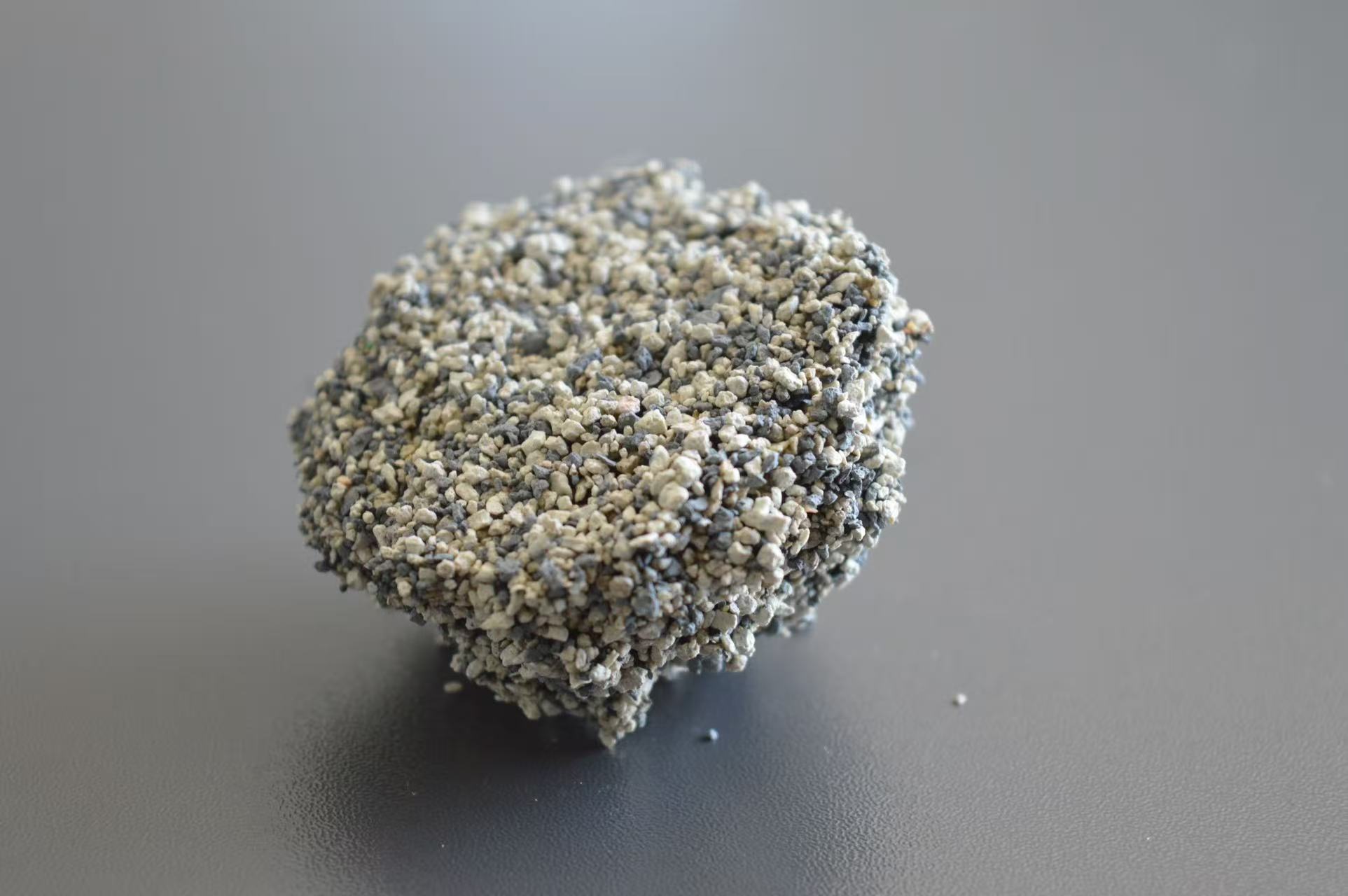
How quickly liquid enters the granule affects how long urine remains near the surface and how far it spreads.
A clump needs to stay together during scooping without crumbling back into clean litter.
A balanced granule range can support absorption, handling and scooping behavior together.
Less spreading means a drier tray around the wet area and a cleaner surface between cleaning cycles.
This is why a powder CEC result cannot predict the full customer experience. The clumping system converts the clay's water interaction into something the owner can physically remove.
05When Activated Carbon and Silica Gel Enter the Formula
In a blended product such as CELAURA 3-in-1 mineral clumping cat litter, each ingredient has a different job. This can broaden the odor-control approach, but the benefit depends on the complete granule system rather than the ingredient list alone.
| Component | Possible contribution | What should be verified |
|---|---|---|
| Bentonite | Provides the mineral base, liquid uptake and clumping structure. | Absorption speed, clump strength, dust behavior and interaction with other components. |
| Coconut-shell activated carbon | May adsorb certain volatile odor compounds, depending on pore structure and loading. | Particle form, distribution, addition level and measured effect in the finished formula. |
| Silica gel granules | Adds supplementary moisture-handling capacity and creates a visible texture in the blend. | Ratio, granule size, distribution and whether moisture management remains balanced with clumping. |
Adding an ingredient does not automatically prove better odor control. Activated carbon can be present at a level too low to show a measurable effect, or silica gel can change moisture behavior in a way that affects clump formation. The finished product should be tested as a system. For a separate look at scent-free odor management, see odor control without added fragrance.
06A Buyer's Evaluation Checklist
A useful comparison combines material data with tests on the actual litter. Start with the raw material, then move to granules and finally measure the odor that reaches the air.
- Confirm the raw-material methods. Record montmorillonite content, CEC or methylene blue results with the exact test method, sample preparation and reporting basis. Numbers from different methods should not be treated as directly comparable.
- Test the finished granules. Check particle-size distribution, dust, absorption behavior and clump strength using the same sample mass and liquid volume for each product.
- Measure ammonia above the used litter. Use a defined litter depth, urine or synthetic load, waiting time, temperature and detection method. Report the result consistently.
- Look beyond ammonia. Assess other relevant odors from urine and feces, because a product that works on ammonium may not address every volatile compound.
- Repeat the use cycle. Observe performance after several wetting events and normal clump removal. A first-use result may not reflect the condition of the tray after a week of use.
A practical comparison rule: if two suppliers report different CEC values, first confirm that the test methods match. If they do not, compare the finished litter under the same use and measurement conditions before drawing a conclusion.
07What This Means for Cat Litter Buyers
Montmorillonite and CEC explain one part of bentonite cat litter's odor-control potential: the interaction with ammonium ions. The experience at home also depends on how quickly urine is absorbed, how reliably the litter clumps, which other odor compounds are present and how easily the used material is removed.
For manufacturers, importers and private-label brands, the stronger approach is to compare both mineral properties and finished-litter performance under the same conditions. Ask for method details, repeatable test results and enough sample material to reproduce the evaluation with your own protocol.
HERMANO NEW MATERIALS supplies bentonite-based cat litter and can discuss product selection for different markets and packaging requirements. To review a mineral base, granule design or performance target for your litter range, contact Hermano with your application details.
08Frequently Asked Questions
Does a higher CEC guarantee better cat litter odor control?
No. CEC indicates the clay's capacity to exchange certain positively charged ions under a specified test method. It can help explain how montmorillonite may interact with ammonium, but it does not measure absorption speed, clump strength, ion competition, other odor compounds or the amount of ammonia that reaches the air. Finished litter performance still needs to be tested.
How does montmorillonite interact with ammonium in cat litter?
Montmorillonite has negatively charged sites balanced by exchangeable cations. Ammonium ions formed from urine can be taken up through cation exchange. This gives the clay a relevant mechanism for retaining part of the ammonium present in a wet litter bed, although the result depends on access to the clay surface and conditions in the litter.
Why does cat urine produce an ammonia smell?
Fresh cat urine contains urea. When urine remains in the litter box, microbial activity can break urea down and contribute to ammonia production. Cleaning frequency, moisture, temperature and the condition of the litter bed can all influence how quickly odor becomes noticeable.
Can pH affect ammonia odor in a litter box?
Yes. Ammonia exists in equilibrium between dissolved ammonium, NH4+, and volatile ammonia, NH3. The balance is affected by pH. Because NH3 is the form that can leave the liquid and enter the air, conditions that shift the balance can change how strongly ammonia is perceived.
Why is clumping important for odor control?
Rapid absorption and a cohesive clump help localize urine and make it easier to remove a source of future odor. If the wet material spreads or breaks apart during scooping, more moisture and odor-forming material remain in the tray. Granule size, particle distribution, absorption speed and clump strength therefore matter.
What should buyers test in finished cat litter?
Useful tests include particle-size distribution, dust, absorption behavior, clump strength and how the litter performs after repeated wetting and scooping. Odor testing should measure ammonia in the air above used litter under defined conditions and also consider other relevant odors from urine and feces.
Does activated carbon or silica gel automatically improve odor control?
No. Activated carbon may adsorb certain volatile odor compounds, and silica gel can contribute moisture-handling capacity, but the benefit depends on the amount, particle form, distribution and interaction with bentonite in the finished product. Each ingredient needs to be evaluated in the complete litter formula.
How should two odor-control claims be compared fairly?
Compare samples under the same litter depth, liquid volume, waiting time, tray size, cleaning cycle and measurement conditions. Ask for raw-material test methods, finished-granule results and repeated-use observations. A single CEC value or fragrance description is not enough to establish overall odor-control performance.
09Technical References
- Hermano cat litter materials - bentonite and functional mineral options for clumping litter products.
- CELAURA 3-in-1 mineral clumping cat litter - a blended mineral example with bentonite, coconut-shell activated carbon and silica gel granules.
- What is 3-in-1 mineral cat litter? - background on the roles of bentonite, activated carbon and silica gel.
- Odor control without added fragrance - a formula-level view of absorption, clumping and moisture management.
- The Clay Minerals Society - clay mineralogy and montmorillonite-related technical resources.
- U.S. Geological Survey - mineral and geological reference information.
These references provide general technical background. They do not constitute certification, endorsement or performance evidence for a Hermano product.

